


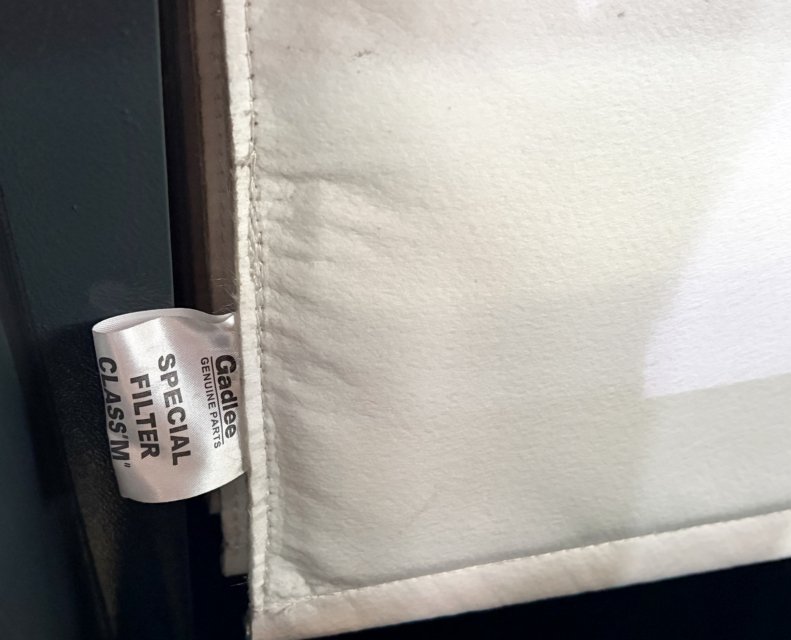
When choosing an industrial sweeper, filtration is an important part of overall cleaning performance. A sweeper does not only collect dust and debris from the floor—it must also prevent fine particles from being released back into the surrounding air.
M-Class is a defined filtration category for dust extraction equipment. It describes the required level of dust filtration performance rather than a specific filter shape or material.
This distinction is important. Terms such as panel filter, cartridge filter, pocket filter, polyester filter, and PTFE filter describe the construction or technology of a filter. M-Class, on the other hand, describes its filtration classification or performance level.
Therefore, an M-Class filter can use different filter constructions or materials, as long as the filtration system meets the relevant performance requirements. For professional sweepers, M-Class filtration is designed to provide a higher level of control over fine dust than basic filtration systems.
M-Class Filter vs. Conventional Sweeper Filters
Not all sweeper filters provide the same level of fine-dust control. Conventional panel or cartridge filters are often manufactured using paper or synthetic filter media. Depending on their design and specification, they can provide basic or general-purpose filtration, but they may be more difficult to clean and can become clogged when exposed to large amounts of fine dust.
Industry filter designs such as polyester pocket filters provide a larger filtration area and can be designed for repeated cleaning. For example, describes its Multipocket filters as washable, tear-resistant, anti-clogging filters with filter-shaking systems to support long-term dust control.
The key difference is therefore not simply “M-Class vs. cartridge” or “M-Class vs. panel.” These terms describe different aspects of filtration.
| Aspect | Conventional Filter | M-Class Filtration |
| Fine-dust control | Depends on filter specification | Designed for a higher dust-filtration classification |
| Filter construction | Commonly panel or cartridge designs | Can use different filter structures and materials |
| Dust loading | Depends on filter area and construction | Designed for demanding fine-dust applications |
| Nettoyage | Depends on filter material and design | Depends on the specific M-Class filter system |
| Application | General cleaning applications | More demanding professional and industrial applications |
For industrial sweepers, the practical objective is to combine fine-dust filtration, stable airflow, effective dust release, and reliable maintenance.
Why Is M-Class Filtration Important for Sweepers?
During sweeping, the main brush and side brushes disturb dust and debris on the floor. The suction system then draws dusty air through the filter before the air is discharged. An effective filtration system therefore needs to do two things:
1. Capture fine dust
The filter helps prevent fine particles from being discharged with the exhaust airflow, reducing dust dispersion during sweeping.
2. Maintain airflow
As dust accumulates on a filter, airflow can decrease if the filter becomes heavily clogged. Reduced airflow can affect the suction system and overall sweeping performance.
This is why filter design is not only about filtration efficiency. Filter surface area, dust release, filter cleaning, and filter-media durability also have an important influence on long-term performance.
Gadlee M-Class PTFE Filtration
Gadlee’s ride-on sweepers use an M-Class PTFE filtration system designed for demanding sweeping applications. The filter combines a polyester filter medium with a PTFE membrane, providing fine-particle filtration while supporting effective airflow and dust release.
According to Gadlee’s filtration test report, the filter achieves:
- Filtration particle size: 0.3 μm
- Filtration efficiency: ≥99.96%
- Filtering surface: 1.60 m²
The test result provides documented evidence of the filter’s fine-particle filtration capability under the specified test conditions.
In addition to filtration efficiency, the filter system is designed with separated polyester elements and internal support to maintain air passages between the elements. This helps provide effective airflow and allows the filtration system to operate under demanding dust conditions.
Why PTFE Filtration?
PTFE membrane technology provides a fine filtration barrier while helping reduce dust penetration into the filter media. For industrial sweepers, this can provide several practical advantages:
1. High Fine-Dust Filtration
The combination of polyester media and PTFE membrane is designed to capture very fine dust particles. Gadlee’s filtration test report records an efficiency of ≥99.96% for 0.3 μm particles under the specified test conditions.
2. Large Filtering Surface
The Gadlee filtration system provides a large filtering surface. The separated filter elements provide effective dust-collection area while maintaining appropriate space for air passage.
3. Effective Dust Release
A filter needs to release accumulated dust effectively in order to maintain airflow during continued operation. Filter cleaning and dust-release mechanisms therefore play an important role in long-term filtration performance.
4. Durable Filter Media
Compared with conventional paper-based filter media, washable synthetic filter materials can be designed for repeated cleaning and demanding working conditions. This type of design is also used in professional industrial sweeper filtration systems. For example, our technical material describes polyester-based Multipocket filters as washable and tear-resistant, with designs intended to reduce clogging and facilitate dust release.
M-Class Is More Than a Filtration Percentage
A high filtration percentage is useful, but it should not be considered the only factor when evaluating a sweeper filter. A professional filtration system should be considered as a combination of:
Filtration Efficiency → Airflow → Dust Release → Durability → Maintenance
If a filter captures fine dust but becomes clogged quickly, airflow can decrease.
If the filter is difficult to clean, maintenance requirements may increase.
If dust remains attached to the filter surface, the effective filtration area can gradually decrease.
Therefore, effective dust control depends on the complete filtration system rather than a single filtration-efficiency figure.
Gadlee Ride-On Sweepers with M-Class Filters
Gadlee has equipped its current ride-on sweeper range with M-Class filtration as standard.
The following models are equipped with M-Class filters:
- Balayeuse autoportée GTS1200
- Balayeuse autoportée GTS1450
- GTS1450HD Ride-On Sweeper
- Balayeuse autoportée GTS1900
This means M-Class filtration is not limited to a special configuration or optional upgrade within these models. It is part of the standard filtration configuration of the above ride-on sweepers.
With M-Class PTFE filtration, these sweepers are designed to provide improved control of fine dust in demanding commercial and industrial sweeping applications.
M-Class Filtration for Professional Sweeping
For a professional sweeper, the filtration system is an important part of overall machine performance. M-Class filtration focuses on controlling fine dust, while the filter material, surface area, airflow design, dust-release mechanism, and maintenance system all contribute to long-term performance.
With documented filtration test results and M-Class filters as standard equipment on the GTS1200, GTS1450, GTS1450HD, and GTS1900, Gadlee provides a filtration solution designed for demanding sweeping environments.
Frequently Asked Questions
Is M-Class the same as a HEPA filter?
No.
M-Class and HEPA refer to different filtration concepts and should not be treated as interchangeable terms. An M-Class filter should not automatically be described as a HEPA filter.
Is PTFE the same as M-Class?
No.
PTFE describes the filter membrane technology, while M-Class describes the filtration classification or performance requirement. A PTFE filter can be designed to achieve M-Class filtration performance.
Is an M-Class filter better than a panel or cartridge filter?
It is more accurate to say that they describe different characteristics. Panel and cartridge describe filter constructions, while M-Class describes a filtration classification. A panel or cartridge filter may have different filtration specifications depending on its material and design.
What is the filtration efficiency of Gadlee’s M-Class filter?
According to Gadlee’s filtration test report, the filter achieves ≥99.96% filtration efficiency for 0.3 μm particles under the specified test conditions.
Which Gadlee sweepers come standard with M-Class filters?
The following Gadlee ride-on sweepers come standard with M-Class filtration:
- GTS1200
- GTS1450
- GTS1450HD
- GTS1900
Conclusion
M-Class filtration is a defined filtration category designed for controlling fine dust. It should not be confused with a specific filter shape or material such as a panel, cartridge, pocket, polyester, or PTFE filter.
For professional sweeping, effective filtration requires more than a high filtration rate. Filtration efficiency, airflow, dust release, filter durability, and maintenance all contribute to the overall performance of the system. Gadlee’s M-Class PTFE filtration, supported by documented filtration test results, is now standard on the GTS1200, GTS1450, GTS1450HD, and GTS1900 ride-on sweepers.
 English
 Chinese
 German
 French
 Spanish
 Japanese


