


Lithium-ion technology is changing the way professional cleaning machines are powered. For scrubber dryers and sweepers, the value of lithium-ion is not simply longer battery life. It is about higher machine availability, less battery maintenance, more flexible charging, and lower operating burden over time.
For facilities with frequent cleaning, long working hours, or demanding schedules, lithium-ion can provide a more flexible alternative to traditional battery technologies.
1. What Makes Lithium-Ion Different?
Lithium-ion batteries differ from traditional lead-acid battery technologies in how they store, deliver, and manage energy.
For cleaning machines, the most important difference is not the battery chemistry itself, but how it affects daily operation.
A lithium-ion-powered scrubber or sweeper can offer:
- Faster charging
- Opportunity charging during breaks or between cleaning tasks
- Longer usable battery life
- No battery watering
- Lower battery maintenance requirements
- More consistent power management
- Higher machine availability
In other words, runtime tells you how long a machine can clean, while uptime tells you how often the machine is ready to clean. Lithium-ion can improve both.
Lithium-Ion vs. Traditional Lead-Acid Batteries
When choosing a battery-powered scrubber or sweeper, lithium-ion and lead-acid technologies each have their place.
| Factor | Lithium-Ion | AGM / Flooded Lead-Acid |
| Charging speed | Generally faster | Generally slower |
| Opportunity charging | Suitable for compatible systems | More limited depending on battery type and system |
| Watering | Not required | Required for flooded batteries; not required for AGM |
| Battery maintenance | Very low | Varies by battery type |
| Service life | Generally longer | Generally shorter |
| Initial investment | Higher | Generally lower |
| Best suited for | Frequent use and flexible schedules | Predictable cleaning schedules and lower initial investment |
The right choice depends on the cleaning schedule, machine utilization, charging infrastructure, and total cost of ownership—not simply the initial purchase price.
2. Faster Charging, Less Downtime
Charging time directly affects machine availability.
Lithium-ion batteries can generally be charged faster than traditional lead-acid batteries, allowing machines to return to work sooner. Some lithium-ion systems can reach a high state of charge within a relatively short charging period.
This becomes especially valuable when a machine is used multiple times throughout the day.
For example, a scrubber can be used during one cleaning period, recharged during a break, and returned to service later. The same principle applies to sweepers working across multiple cleaning zones.
3. Opportunity Charging for Greater Flexibility
One of the most important advantages of lithium-ion technology is opportunity charging.
Instead of waiting until the battery is almost empty before charging, compatible lithium-ion systems can be charged during suitable breaks, between shifts, or whenever the machine is not in use.
This allows operators to take advantage of available charging time without following the same charging routine required by many traditional battery systems.
For facilities with long or variable cleaning schedules, this can reduce unnecessary downtime and help keep machines ready for the next task.
4. Less Battery Maintenance
Traditional battery management can require additional operator attention.
Flooded lead-acid batteries, for example, require regular watering and proper maintenance. Lithium-ion batteries eliminate battery watering and significantly reduce routine battery-management work.
This means operators can spend more time cleaning and less time:
- Checking battery condition
- Adding water to flooded batteries
- Managing battery charging procedures
- Performing routine battery maintenance
However, low-maintenance battery technology does not mean the entire cleaning machine is maintenance-free. Brushes, squeegees, filters, tanks, vacuum systems, and other machine components still require regular cleaning and maintenance.
5. Longer Battery Life and Lower Replacement Frequency
Battery replacement is an important part of the long-term cost of a cleaning machine.
Lithium-ion batteries generally offer a longer cycle life than many traditional lead-acid options. Some professional lithium-ion systems are rated for more than 2,000 charge cycles, helping reduce the frequency of battery replacement.
A longer battery life can contribute to a lower total cost of ownership, particularly for machines that are used frequently.
However, battery life depends on the specific battery system, charging conditions, machine usage, temperature, and other operating factors. Therefore, the battery specification and warranty should always be considered when comparing solutions.
6. Higher Machine Availability
The biggest operational benefit of lithium-ion is often availability, rather than simply longer runtime.
A machine may have sufficient battery capacity for a full cleaning shift, but if it requires long charging periods afterward, its availability can still be limited.
Lithium-ion addresses this through a combination of:
Longer usable runtime + faster charging + opportunity charging + low maintenance
Together, these features can help keep scrubbers and sweepers available for more of the working day.
This is particularly valuable for:
- Warehouses and logistics centers
- Manufacturing facilities
- Shopping malls and retail stores
- Airports
- Hospitals and healthcare facilities
- Schools and universities
- Large commercial buildings
- Facilities with multi-shift cleaning
7. Integrated Battery Management and BMS
Lithium-ion performance depends not only on the battery cells but also on how the battery communicates with the machine.
A professional lithium-ion system should ideally be designed as an integrated battery and machine solution.
The Battery Management System (BMS) continuously monitors and manages key battery conditions, such as voltage, current, and temperature. It can also communicate with the machine to help protect the battery, equipment, and operator when abnormal conditions are detected.
An integrated system can also make operation easier by providing battery status directly through the machine’s interface, allowing operators to monitor remaining power without interrupting cleaning.
For this reason, choosing a fully integrated lithium-ion solution is generally preferable to simply replacing a traditional battery with an aftermarket lithium-ion battery.
8. Lithium-Ion for Both Scrubbers and Sweepers
Lithium-ion technology is not limited to one type of cleaning machine.
Floor Scrubbers

For scrubber dryers, lithium-ion is particularly useful when:
- Cleaning schedules are long or unpredictable
- The machine is used several times per day
- Fast charging is important
- Operators need flexible charging
- Battery maintenance needs to be minimized
スイーパー
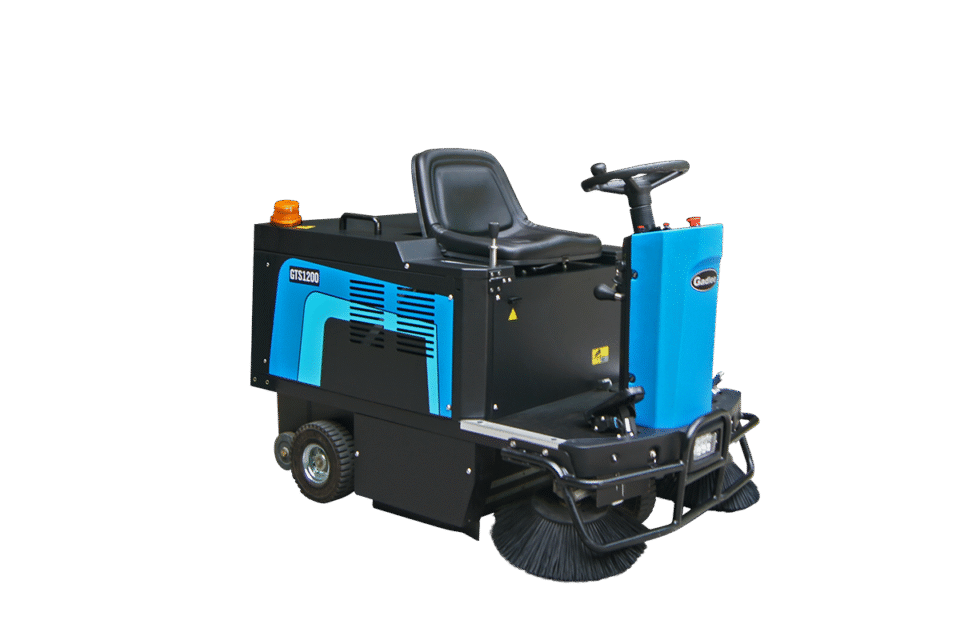
For sweepers, lithium-ion can provide similar operational benefits while also supporting indoor and noise-sensitive applications.
Battery-powered sweepers produce no on-site exhaust emissions, making them suitable for many indoor environments where combustion-powered equipment is inappropriate.
Lower operating noise can also be beneficial in areas such as warehouses, retail facilities, schools, hospitals, and other occupied spaces.
9. Is Lithium-Ion Worth the Higher Initial Cost?
Lithium-ion machines generally require a higher initial investment than comparable machines equipped with traditional batteries.
However, purchase price is only one part of the cost.
A more useful comparison is Total Cost of Ownership (TCO), which can include:
- Battery purchase and replacement
- Electricity consumption
- Battery maintenance
- Operator labor
- Charging time
- Machine downtime
- Cleaning productivity
- Expected service life
For heavily used machines, reduced maintenance, fewer battery replacements, faster charging, and higher availability can help offset the higher initial investment over the machine’s operating life.
For machines used only occasionally, the financial advantage may be less significant.
Therefore, lithium-ion is most valuable when the machine has high utilization, demanding schedules, or a strong need for flexible charging and low maintenance.
10. How to Know If Lithium-Ion Is Right for Your Facility
Lithium-ion is worth considering if your cleaning operation has several of the following characteristics:
- The machine is used frequently throughout the day
- Cleaning schedules are long or variable
- Downtime has a significant operational impact
- Opportunity charging would be useful
- Battery maintenance needs to be minimized
- The machine operates across multiple shifts
- Fast charging can improve workflow
- Long-term operating cost is more important than initial purchase price
If the machine is used for a short, predictable cleaning period once a day and has sufficient time to recharge afterward, a traditional battery may still be a practical choice.
The best battery technology is therefore not necessarily the most advanced one—it is the one that best matches the cleaning workflow.
よくあるご質問
Is lithium-ion better than lead-acid for floor scrubbers and sweepers?
Not in every application. Lithium-ion offers advantages in charging flexibility, maintenance, battery life, and machine availability, while lead-acid batteries can have a lower initial purchase cost. The right choice depends on machine utilization and cleaning requirements.
Can lithium-ion batteries be opportunity charged?
Compatible lithium-ion systems can generally be opportunity charged without the same battery-life concerns associated with opportunity charging traditional lead-acid batteries. Always follow the battery and machine manufacturer’s charging requirements.
Do lithium-ion batteries require watering?
No. Lithium-ion batteries do not require the routine watering associated with flooded lead-acid batteries.
Do lithium-ion batteries last longer?
Lithium-ion batteries generally provide a longer cycle life than many traditional lead-acid batteries, although actual service life depends on the battery system and operating conditions.
Does lithium-ion make a cleaning machine maintenance-free?
No. Lithium-ion significantly reduces battery maintenance, but the cleaning machine itself still requires routine maintenance and cleaning.
Is lithium-ion suitable for multi-shift cleaning?
Yes. Fast charging, opportunity charging, longer battery life, and low maintenance make lithium-ion particularly suitable for machines with high utilization and demanding cleaning schedules.
Conclusion
Lithium-ion technology is more than a different type of battery. For professional floor scrubbers and sweepers, it can change how machines are charged, maintained, scheduled, and utilized.
The key benefits are:
- Faster charging.
- Opportunity charging.
- Less battery maintenance.
- Longer battery life.
- Higher machine availability.
- Lower operating burden over time.
For facilities where cleaning equipment needs to be ready when work begins—and ready again when the next task starts—lithium-ion can provide a more flexible and efficient power solution.
 English
 Chinese
 German
 French
 Spanish
 Japanese


